Showing posts with label Korea - Spring. Show all posts

Saturday, July 06, 2019

[Seoul Travel] Lotus Lantern Festival (Yeon Deung Hoe)

The Lotus Lantern Festival (Yeon Deung Hoe) is a 3-day event held annual in Seoul. In 2019, it was from 3 to 5 May 2019. For those who are familiar with the lunar calendar, the Buddha's Day is celebrated on the 8th day of the 4th lunar month in Korea. The Lotus Lantern Festival is usually held 1 week before the actual day. For 2020, the dates for Yeon Deung Hoe will be from 24 to 26 April 2020.

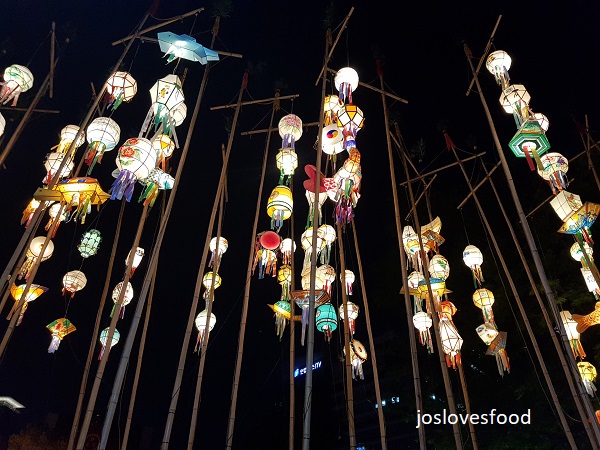
The event would commence on a Friday and there are lantern exhibitions at Jogyesa, Bongeunsa and Cheonggyecheon over the 3 days. Below is a photo of the lantern exhibition at Bongeunsa, located near COEX.


On the 2nd day, which is a Saturday, the various Buddhist temples would commences the ceremonial events such as the bathing of the baby Buddha's status and daily chanting. This signifies the cleansing of one's own defilement (greed, anger and delusion). They would also be busy with their final rehearsals to give their best for the evening's parade.


A Buddhist Cheer Rally would be held at Dongguk University from 4.30pm. This is where all the parade participants would gather before the commencement of the parade. The parade would take place along Jongno (central of Gangbuk area) from 7pm to 9.30pm. There are seats lined on both sides of the Jongno and pre-registration is needed to secure tickets for the seats. Those without tickets may stand and watch the parade too, thought it can be a little tiring. Audience are encouraged to join the parade towards the tail-end and take part in the walk until the post-parade celebration at the Jonggak Intersection. Over there, there will be stage performances until 11pm.


Below is a photo of the stage at the Jonggak Intersection.  Most of the audience stayed till the end of the concert.


The roads leading to Jogyesa remained crowded as the audience tried to get upclose with the big lantern floats!  Jogyesa was all lit up that evening.


On the 3rd day, the area in front of Jogyesa is turned into a carnival street with many cultural events and stall lines on both sides of the street. The area is blocked and vehicles are have to be detoured to other road. Participants can walked along street freely and take part in the carnival events which has tea appreciation, meditation sessions, photo exhibitions and several handicraft-making stations.


The closing event, from 7pm to 9pm, is an energy-charged event with youths from different universities and temples coming together to put up the final show near Jogyesa.


It was an eye-opener to see how Koreans celebrate the Lotus Lantern Festival.  The colourful performances, the enthusiasm from the parade participants, the helpful event ushers and the vibrant atmosphere definitely made my trip worthwhile.

For those interested to experience this festival, information is available on the official website http://www.llf.or.kr/eng/


Saturday, June 15, 2019

[Seoul Travel] Dongguk University and Lotus Lantern Festival


One of the places i like to visit when i am in Korea is the university campus. The environment is usually beautiful and it gives you the positive vibes. This is Dongguk University (동국대학교) located in Seoul. I was there in May this year during the Lotus Lantern Festival (Yeon Deung Hoe), which is a highlight event during Budhha's Day in Korea.

The campus may not be as big as some of the universities in Seoul but it is a scenic place to walk around with tall green trees.


Every year, the Buddhist Cheer Rally is held at Dongguk University's Stadium. A feast of laughter and joy where the lantern parade participants, arrayed in their traditional Korean costumes, hanbok, rally together, laughing and dancing before the lotus lantern parade begins.


This is one of the filming sites for a 2018 Korean Drama, Encounter (aka Boyfriend) starring Park Bo Gum and Song Hye Gyo. Jinhyeok (PBG)' graduation scene was filmed at the entrance of Myeongjin Hall.
Catch a short glimpse of Jinhyeok's graduation video here.


Dongguk University (동국대학교) is a private, coeducational university in South Korea, based on Buddhism. Established in 1906 as Myeongjin School (명진학교) by Buddhist pioneers of the Association of Buddhism Research, the university gained full university status as Dongguk University in 1953. The university remains one of the few Buddhist-affiliated universities in the world, and is the member of International Association of Buddhist Universities.


Dongguk University's main campus is located in Jung District, Seoul, just north of Namsan. The upper buildings of the campus are directly connected into the trails of Namsan park.

The campus' main entrance is at Dongguk University Station the intersection of Seoul Subway Line 3 and 4. Chungmuro Station is near the rear entrance.

The 2020 Lotus Lantern Festival will take place from 24 to 26 April. There are events where priority is given to travellers such as tickets to watch the lantern parade and lantern making events. Interested participants may apply for tickets via the LLF website.

http://www.llf.or.kr/eng/info/festival.php?wr_id=9

Zoom into the map to check the walking direction from Dongguk University Station to the campus.


Thursday, March 22, 2018

Spring in Korea 2015 (Part 5) ~ Exploring Haeinsa (Tripitaka Koreana)

Built 1,200 years ago, the Haeinsa Temple is regarded as one of the three most important temples in Korea, representing the Triple Jewels - Buddha, Dharma and the Sangha.  The other 2 temples are Tongdosa and Songgwangsa.

Located in Gaya-san, Hapcheon province, Haeinsa Temple is said to be home to the largest number of monks who cultivate themselves religiously in Korea.  The temple has a long history and is notable for housing the Tripitaka Koreana (Goryeo Daejanggyeong aka Great Collection of the Scriptures of Goryeo), the vast canon, proudly asserts that it is the utmost symbol of Goryeo Buddhism.  It has a great collection of scriptures in more than 80,000 woodblocks.  The scriptures are carved on both sides of these blocks and make a total of some 160,000 pages.  Each side has some 300 characters and as such, the entire Tripitaka has some 52 million characters.

The temple has since been included in the UNESCO World Heritage List in 1995.  It is the first temple dedicated to the Korean Avantamsaka School of Buddhism and it houses the most comprehensive woodblock edition of Buddhist scriptures ever made.  The first woodblock version was compiled in China during the Song Dynasty.  But all of the early Chinese editions were somehow destroyed.  It was first destroyed during the Mongol invasions in the early 13th century.  History textbooks explained that the Goryeo government undertook the project with the hope of expelling the Mongol invaders with the assistance of the Buddha.


The temple's layout is typical of a Korean mountain monastery.  Let's explore this historical temple.

The first entrance into the temple is the One Pillar Gate which symbolises an aspiration towards Buddhahood.  The gate itself represents the teaching of the Buddha that all things are illusionary, they aren't what they appear to be.  Translating from the Chinese words, it also means the Gate of Non-Duality and it means the one-ness of all things and phenomena.

(The main gate facing outside)

(The main gate facing inside)

Not too far from the first gate stands the Gosamok Tree, which is a zelkova planted 1,200 years ago to commemorate the establishment of the temple.  It is said that the king then planted this tree on his own in gratitude of the monks who helped to heal his queen of her disease.  The tree has since withered but it is still kept as a monument in the temple.


The next gate, which leads to the main temple compound, is the Haein-Chongrim which means the Haein Forest Monastery.  This is also the Cheongwang-mun which enshrines four fearful-looking guardians of the heavenly king who guard the Buddhist world and fight off the evil.

(Pheonix Gate)

The storage halls of the Tripitake Koreana are located on the highest level of the temple compound, and designed to facilitate natural ventilation, humidity and temperature control with no obvious device other than the open grill windows.


The compound consists of 4 buildings and each building is laid out in rectangular shape.  With careful planning, the buildings face the southwest so as not to get direct sunlight.  And to maintain the right humidity inside the buildings, salt, charcoal, powdered lime and sand are used in the inner floorings.


The Tripitaka Koreana consists of three collections - Buddhist Scriptures, Precepts and Discourses.  The Buddha was a great teacher born more than 2,500 years ago and taught the way for liberation for 45 years.  These collections captured the Buddha's words systematically.

The Tripitaka Koreana is also called the Goryeo Daejangkyung (高丽大藏经) because it was published in the period of Goryeo and it reflected the people's aspirations for overcoming the nation's crisis by relying on the Buddha's teachings against the invasion of the Kitan and the Mongols.

Each block measures about 68cm by 24.5cm, and weighs about 3.2kg.  Unfortunately, the halls are not open to the public and I could only view the wooden blocks through the gaps outside the halls.  Only 1 piece amongst the thousands of wooden blocks was on display, which has the Heart Sutra text engraved on it.


Haeinsa is the first temple in Korea dedicated to the Korean Avantamsaka School of Buddhism, and hence the master Buddha of the Avantamsaka Sutra, Vairocana Buddha, is enshrined in the main hall known as Daejeokgwagjeon, meaning the Hall of Great Silence and Light.


Stone Pagodas are found in most (if not all) temples.  Historically, pagodas were meant to house the remains of the Buddha.  In Korea, these pagodas house the remains of Buddhist monks or nuns in that monastery.  Therefore, it is not unusual to see people paying respects to such pagodas.


 For temples that are found in the forests, the compound is spacious and there is usually an open hall (Bumjong Gak) with 4 percussion-like instruments.  Known as Samul, they include the Dharma Bell, the Dharma Drum, the Wooden Fish and the Cloud Gong.


The Dharma Drum sends the message of the Dharma to lead all land animals to enlightenment.


The Dharma Bell is rung to redeem the souls of beings in hell, to gather people in the temple, and to announce the time.

The striking of the cloud bell, usually made of bronze or iron, is to lead all air-living creatures into the heavens.


The Wooden Fish is in the shape of a carp and the hitting on this instrument is meant to send message to beings living in the water so that they will realise the awakening too.


In case you are wondering if there is anything less religious, there is a cosy tea-house, Haein Café, in the temple's vicinity!  It is an ideal place to really rest, chill and relax.


The overall experience in Haeinsa has been an pleasant and peaceful experience.  The key to visiting temple is to allow yourself time to explore and immerse into the serenity.  The compound is big and is surrounded by a several other smaller temple.  Every turn is an experience!


Getting to Haeinsa
- From Dong Daegu KTX Station, walk to the Daegu Subway station (2 mins)
- Take Line 1 (Red Line) to Seongdangmot Station (9 stops, 15 mins)
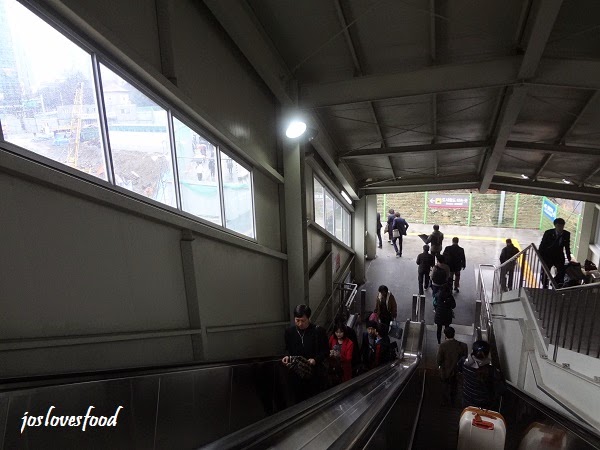
- Exit the station by taking the lift to the street level (Exit 3) and walk to the West Daegu Intercity Bus Terminal (2 mins)
- Buy the bus ticket to Haeinsa.  Bus leaves every 40 mins.  The journey takes about 1.5 hours.

There is quite a distance to go even after you've passed the Haeinsa gate.  I alighted at the last stop where there were shops and hotel-alike building and took a taxi to Haeinsa temple.  The journey took about 5 mins.

Wednesday, April 15, 2015

Spring in Korea 2015 (Part 3) ~ Getting to Haeinsa (Tripitaka Koreana)


Travelling in Seoul has always been a breeze for me.  However, getting out there, out of Seoul may seem like getting out from our soul.  It can be scary but fret not.  Korea's transportation system is pretty good.  Some tips to share:
 
1.  Load your T-money card with extra value as most of the transportation system (buses, metro and even KTX) would accept using the T-money and in case, you can't find a reload machine while in a hurry to catch the arriving bus.  However, intercity buses may not accept the use of T-money because the fare may differ from timing to timing because the bus operator may be different.
 
2.  Keep some small notes and loose change in case your T-money card runs out of value.  The fare for local buses costs 1,100 to 1,200 per trip regardless of distance.
 
3.  Ensure you have data-plan on your mobile device and not to just rely on free wifi.  In case you need to check the location map or the translation app at some rural cities.
 
4.  Travel light.  Backpacks and lightweight jackets would be good.  While inter-city buses have separate luggage storage compartment, this is not the case for local buses.  You will need to lug your luggage onboard and hold tight to them so that the luggage will not roll away.
 
5.  Bring some heat packs (especially during the colder seasons).  Food and drinks are optional as you can purchase them on KTX.
 
6.  Have your headphones if you wish to plug in to listen to their local radio channels.
 
 
Ready, get set, go to Haeinsa!
 
Here's the details about the journey to Haeinsa.  From Seoul Station, we took the KTX (Korean Train Express) to Dong Daegu Station.  (Note: There is Daegu and Dong Daegu station, be sure to buy tickets for the correct destination.)  KTX is the high speed train system in Korea that runs from Incheon Airport to various parts of Korea such as Busan, Yeosu, Mokpo and Gwangju.  Information about KTX travel and reservation information can be found here.  You can either reserve tickets online (so that you can secure the seats ahead of departure) or get the tickets at the counter.


This is the entrance to Seoul Station, which is a really huge station for passenger transit station be it for KTX train, rail train or subway train.


This is the ticketing counter, which is visible the moment you enter the train station entrance.  There are separate queues for those who reserved tickets online and those buying on the spot.


On the ticket, it shows the travelling date (Year/Month/Date) and time.  The subsequent lines show the train number (KTX 133), the cabin number (No. 14) and Seat number (2B).  On the right, it shows the departure destination (Seoul) and arrival destination (Dong Daegu).  Beneath that, it shows the fare amount (42,500 won).  Unfortunately, it doesn't state the estimated arrival time. 


Once you have gotten the tickets, check the digital signboard for the platform number that you ought to be heading towards.


Take the correct lift that brings you to the track.  The huge numbers plastered at the lift's side door denotes that platform which the lift will bring you to. 


Each lift serves 2 platforms/tracks. 


At the platform itself, the hanging signage indicates the direction in which the incoming train is heading towards.


Look out for the floor signage which indicates the cabin number.


The KTX trains have overhead storage compartment for small luggages.  Bigger ones are to be stored at the separate compartment near the train doors.  Do note that the seats are not rotatable. Hence you may be assigned seats that are in the opposite direction of the moving train.

The journey from Seoul Station to Daegu Station took about 1 hour 55 mins. 


Here's the transfer direction to the Dong Daegu metro station.  Upon exiting the to the public area at the ground level, turn left and walk straight. 


There are lots of shops and restaurants on both aisles.


Once you see the Andong Bakery Shop, turn right and exit the station via Exit 2.


Go along the sheltered walkway.


After the exit, take the downward-riding escalator.  There is an elevator next to the escalator which can be used if you have a heavy luggage.


Once you reach the ground level, turn left.  The metro station entrance will be just around the corner.  To use the elevator, do not enter the entrance.  Instead, follow the pedestrian path and keep walking.


Take the metro to Seong Dang Mot (성당못) station (station number 123).  The journey from Dong Daegu will take about 20 mins.


Take the elevator from the train platform level to the gantry level.


Look out for the signage pointing to the Seobu Bus Terminal and take the elevator.


Once you exit the elevator, turn right and look out for the words "TIM" on the low building.  That's the shortcut and back entrance to get into the intercity bus terminal.


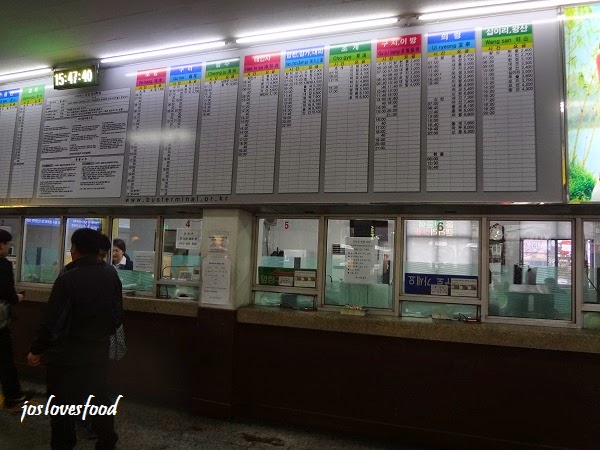
As this is an intercity bus terminal, there are buses that bring passengers to different parts of Korea.


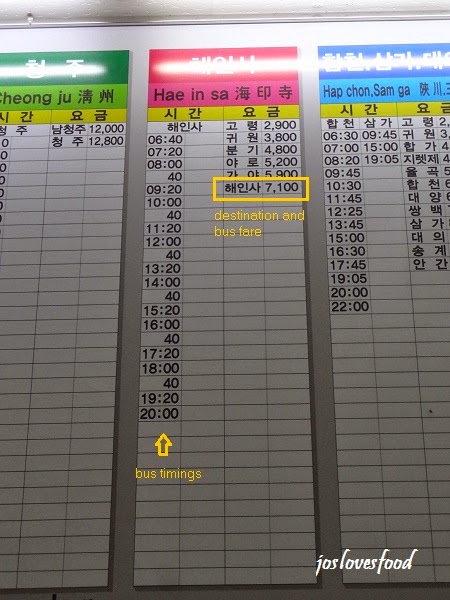
This pink signage provides the bus departure timings, the names of bus stops along the way to Haeinsa and the corresponding bus fare.  So.... Haeinsa is the last stop and the fare was 7,100 won (approximately USD 7).


The bus ticket will show the platform number for the bus departing for Haeinsa.


There are a couple of snacks stalls and coffeeshops at the bus terminal. 


Exit the ticketing area to get to the bus bay for boarding.  These intercity buses have luggage compartments.  However, the bus drivers will be assist with the loading of luggage.  Be prepared to DIY!


If you do not understand Hangeul, at least make sure you can recognize the characters for the destination that you are heading to.  For example, 해인사 means Haeinsa.  Double-check the destination of the bus before boarding.


The seats on the buses are quite comfortable.  Eating and drinking are allowed onboard.


After about 1.5 hours' journey, we finally arrived at Haeinsa bus stop.  This is the last stop for the route.  A couple of things to note:

1.  The bus will stop at Haeinsa's ticketing entrance and you are required to pay for a 3,000 won admission ticket to the temple.
2.  It is not advisable to alight at the admission ticketing stop because it is a very long walk into Haeinsa and if you do so, you may get lost in the compound which is really huge.
3.  The temple is nowhere in sight when you alight at the Haeinsa bus stop.  The buildings opposite the bus stop are guesthouses and hotels for temple visitors, I suppose.

To get to Haeinsa, you will need to transfer to a taxi.  It is a 5-minute journey and the standard fare is 5,000 won.  This is not a metered-fare and there is no need for negotiation with the taxi driver.


We finally figured out that we needed to take a taxi and were finally on our way to Haeinsa.


We finally, finally arrived at Haeinsa.  This is the dormitory building for temple-stay participants.

To get to the temple-stay office for registration (registration timing is between 3pm to 4pm), enter through the small traditional door at the left-end of this building and take the stairs up 1 level.


It is a short flight of stairs.  But, if you have a heavy luggage, you can choose not to lug it up. 


Once you reach the upper level, turn right and look for the temple-stay office!


And Yes!  Welcome to Haeinsa Temple-stay Programme!!

To get a better orientation about the location of Haeinsa, check out this map!  And if you're interested to know more about the buildings within the temple, stay tuned for my next blog post! :D


Related Posts Plugin for WordPress, Blogger...