Wednesday, October 16, 2013

[Seoul, Korea] MBC Show Champion

One of the activities which I enjoy doing most is to watch live music shows.  It has almost been 10 years since I last watched a live music programme.  Back then, it was Music Bank.  It lasted such a deep impression as I recalled that popular singers back then namely UN, Se7en and perhaps Kim Jong Kook sang live.

This time round, the feeling of watching a live programme, MBC Show Champion, was nostalgic.  I didn't get high or scream till my throat burst when the singers appeared.  Perhaps there was a generation gap but the truth is I haven't been able to keep up with the number of new singers who debut every year, or maybe every month.  Sometimes, I felt encouraged by these young people who has stepped out and daringly pursue their dreams despite that the Korean entertainment industry is extremely competitive.

Some highlights from that evening...

Groovy ballad singer, K Will, with his catchy "Love Blossoms" won the Champion Song that evening. 


Powerhouse duo, 15&, won the audience's attention with "Somebody".


ZE:A FIVE with "The Day We Broke Up"


Interview with BTOB.


The show hosts, Amber and Ham Eunjung, were great chirpy and chatty pair!  They look really young, energetic and sporty, don't they?

Sunday, October 13, 2013

SG Cafe Series: Kith Cafe


This is 1 café which appears to be full-house almost ALL the time.  If you go on weekends, it is not advisable if you go with an empty stomach.  Simply because - be prepared to queue and wait.  The café is packed especially during breakfast!


There are seats in both the indoor and outdoor sections but seating capacity is limited by the shop space.


The service staff are quite efficient and experienced.  There aren't the typical pretty-looking waiters and waitresses that you may find in our cafes.  The feeling I get at the café is rather homely... it is like visiting a neighbourhood coffeeshop (abit an atas one) but in downtown.


Tried the Spanish Hot Chocolate with Fresh Cream.  It tasted great!  The chocolate was thick and the satisfying thing is that - it tasted like cocoa.  This is not meant to be lame because too many cafes serve hot chocolate that does not meet the drink's standard. 


Bought these golden-coin butter cookies too.  The cookies are big, really rich (and complete) in taste and fresh!  2 thumbs up from me.  If you enjoy rich cookies, you will love this! 

Kith Café
Park Mall
9 Penang Road #01-01E
Opening Hours: 8am to 10pm

URL: http://kith.com.sg/

Getting there:
Train MRT and alight at Dhoby Ghaut Station.  Take the Orchard Road exit and walk towards Penang Road, Park Mall.


View Larger Map


Related Posts:
- The Little Prince Café (click)
- Kki Sweets (click)

Thursday, October 10, 2013

[Incheon, Korea] Autumn Series: Up Close and Personal with Seagulls


This is a short post to share a memorable experience on-board a ferry which brought me from Incheon to mainland Korea.  Has anyone tried taking a huge ferry across the deep blue sea in the Land of the Morning Calm?
 
In Korea, it is not uncommon to see extremely huge ferries that transport cars and buses across the sea.  That was my tour coach and see how spacious the ferry was.


Due to the size of the ferry, it is extremely stable and you can hardly feel the motions while on board.  Took the opportunity to watch the beautiful sunrise.


Seagulls fly freely, sometimes even onto the ferry.  Prawn crackers are tossed into the air and the hungry seagulls would rush to catch the falling crackers. 


The close and intimate interactions is something that I would never get to see while back home.  =)

Monday, October 07, 2013

[Jeollanam-do, Korea] Autumn Series: Rail-Biking Along Seomjingang River

Seomjingang River, one of the four major rivers in Korea, starts from Imsil and Sunchang. It merges with several bodies of water in Gokseong-gun, Gurye and Hadong before flowing into the South Sea.  With the cool weather, rail-biking is one way to enjoy the scenic Seomjingang River scenery, in Gokseong County. 


Rail biking is a self-powered pedal vehicle and runs on railroad tracks.  Work in a pair or 2 pairs, and it is great fun for family and friends.  The rail bike starts from Chimgok Station and ends at Gajeong Station.  Enjoy the gentle breeze as you pedal through the rail road, which is approximately 5.1km long between the 2 points.


Enjoying the clear, blue skies... as a safety precaution, we were asked to keep a distance from the vehicle ahead.  On the vehicle, there is a small storage area for bags and stuff but it is definitely not big enough to keep big items!


Views of Seomjingang River.  Clear river water runs through peacefully, quietly and slowly... 


Roads are clear, no messy congestions, no honks, no hurry ~


Riders take our time too ~ enjoy the cool wind, savour the moments with nature, have a chat with your partner, crack some jokes, take turns to pedal the vehicle.... that's how life should be.


Reality sets in as we end the tranquillity of the Seomjingang River Rail Bike but memories stay. 

Our destination was the Gajeong Train Station.  Around the station, there are a number of restaurants, temples, markets and pensions too.  It is possible to stay over for a night or two at the vicinity of the Gajeong Station.


Getting to Chimgok Station:

Take a bus from Seoul Central City Bus Terminal to Gokseong Bus Terminal.
(Bus schedule: 15:00 / Estimated travel time: 3hr 45min)

Alternatively, take the KTX from Yongsan Station (Seoul) to Gokseong Station. 
(Train schedule: 08:20am and 19:20pm; 2hr 49min ride)

It takes about 5 to 10 mins by taxi and 20 to 30 minutes on foot from Gokseong -eup Bus Terminal to the Rail Bike Station.


View Larger Map

Friday, October 04, 2013

[Singapore Restaurant] A Korean Style Chicken Restaurant : Chicken Up (한국 치킨 전문점)

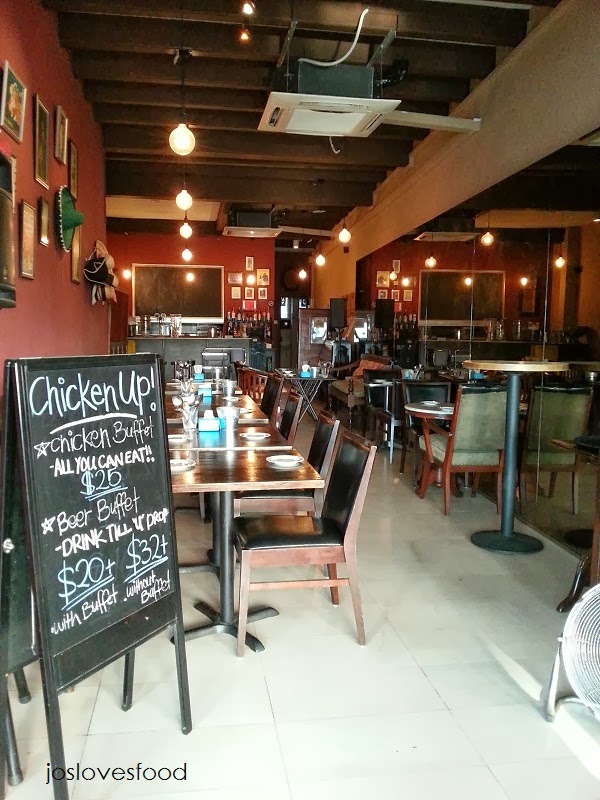
As I walk along the stretch of Tanjong Pagar Road starting from Orchid Hotel toward Maxwell Market, I realise that many new Korean restaurants have joined in the wave of hallyu in Singapore.  Other than what we normally get ie.  BBQ, stews and rice, one shop stood out from the rest.  They serve mainly chicken dishes, and Korean Fried Chicken (KFC) is their specialty which is why they are also known as 한국 치킨 전문점, meaning Korean Chicken Specialty Shop.  This shop is Chicken Up.  This new KFC is totally different from the usual KFC (Kentucky Fried Chicken) and it is worth a try.  Best part of it is that you can opt for ala carte or chicken buffet!

The main entrance


The front façade


Chicken Up has been around for about 3 years.  The main restaurant can take up to about 40 guests indoor.  There are also some outdoor seats.  Chicken Up has recently taken over the space next door and expanded its seating capacity.  It is generally an ideal place for gatherings with friends and colleagues, especially if they are K-pop fans.  Immerse in an evening of continuous latest hits which savouring the chicken dishes.


On each table is a small thrash can and it is meant for the chicken bones.  Truly, that's how the Koreans eat fried chicken in Korea!!


There are also some secluded seats behind the main counter which has more privacy.


The newly acquired restaurant uses open concept although it is also air-conditioned.


All-You-Can-Eat Chicken Buffet costs $25 (before tax) per person.  Go for this option if variety is something that you like to have.  Comparing the cost of Korean Fried Chicken against other Korean restaurants, the price is reasonable.  To get into the real mood of eating Korean Fried Chicken, you can top it up with some beer.  치맥 (chicken & beer) is really really popular in Korea.  Note that on Fridays and eves of public holiday, there is a $5 surcharge for the buffet.

Chicken Up has several fried chicken options including Curry Up, Spicy Up, Mild Up, YangNyeom, Soya Chicken and Popcorn Chicken.  The other options include Andong Chicken Stew, truffle fries and salad.


Soya Chicken (간장치킨) comes in chicken wings and this is my favourite.  The savoury and slightly sweet crispy wings are really delicious.   The wings are quite big, tender and juicy.


The Yangnyeom chicken (양념치킨) is 2nd on my favourite list.  Chunky pieces of chicken were deep-fried before coated with a layer of sweet, sticky and slightly spicy sauce.  These are delicious but perhaps the pieces were way too chunky.


Other than the 2 fried chicken dishes, I personally like the Andong Stew Chicken which isn't commonly found in Singapore.  As the name implies, this dish originates from the city of Andong in the Gyeongsang province in Korea.  Other ingredients used in this dish include mainly glass noodle, potato, carrot and onion and together with spicy soy-based sauce and dried chilli.  In Chicken Up's version, rice cakes and lots of sesame are also added! 


Spicy Up is the signature dish at Chicken Up!  The pieces, a mix of breast and thigh pieces, are big as well and very crispy.  However, the taste is a tad ordinary which can be found in some other Korean fried chicken stalls/restaurants in Singapore.


The waiting time for the fried chicken generally takes about 15 to 20 mins.  The chicken dishes aren't pre-cooked and heated up upon order.  I guess that is a little price to pay for freshly cooked food.  In the meantime, salad is also available on the buffet list.  The fresh veggies mixed with thousand island salad offers a refreshing taste to the sinful fried dishes and provides some balance to the diet. =)


Chicken Up 
48 Tanjong Pagar Road #01-01, Singapore 088469
Tel: 6327 1203
Opening Hours: 5.30pm to 2am daily. 

Getting there: Take the mrt to Tanjong Pagar Station.  At Exit A, walk towards Peck Seah Street, then Tras Street and finally Tanjong Pagar Rd in the direction towards Maxwell Market.  It is diagonally across Fairfield Methodist Church.


View Larger Map


Like my post?  Follow me at Instagram (@joslovesfood), Facebook (Joslovesfood) and Twitter (@Joslovesfood)! ^^

Thursday, October 03, 2013

KrispyKreme : Opens at Tangs on 12 Oct 13!

Finally, the wait for Krispy Kreme's glazed donuts will soon be over!
 

Tuesday, October 01, 2013

[Jeollabuk-do, Korea] Autumn Series: Exploring In and Around the Jeonju Hanok Village


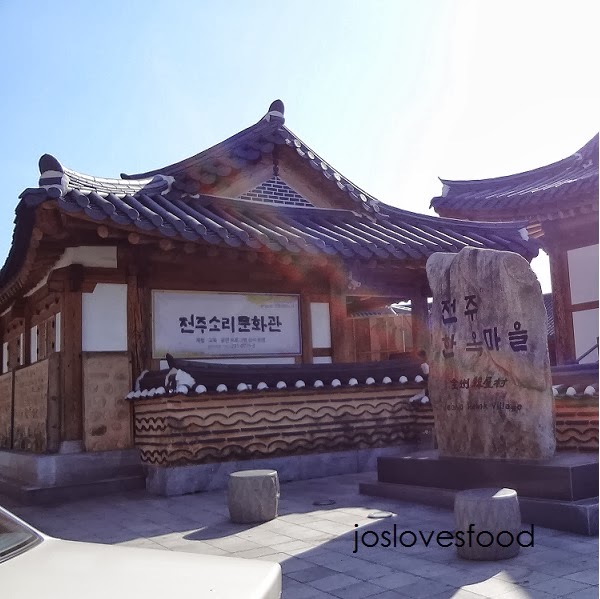
전주 한옥마을에 가자!  Jeonju is an ancient city located in the Jeolla province, south of Seoul.  It is the home to pansori, a genre of musical story-telling, and is famous for the hanok village (Korean traditional houses) and hanji (Korean traditional paper).  The city is famous for 2 cuisines, bibimbap (Warm rice topped with various coloured ingredients) and hanjeonsik (Korean's traditional full-course meal).

Jeonju has more than 800 traditional houses, the largest cluster of traditional houses in Korea.  These houses were built decades ago and have been preserved to date for its historical charms and traditions.


Staying in hanok (Korean traditional houses) brings travelling in Korea to a new dimension.  Over there, I learnt what it means to be "back to basics" and how "communal living" is like in a traditional manner.  The rooms were constructed in a way that faces a common area where communal activities can be carried out.


The interior and exterior of the houses were made of natural materials, mainly wood and paper.  Notice the stacks of logs at the side of the house?  These were used to maintain the traditional ondol floor-heating system since Koreans enjoy sitting, eating and sleeping on the floor.  Heat maintenance is particularly important especially during the colder seasons (late autumn until early spring).


The room facilities were really basic.  No TV, no attached bathrooms.  Common bathrooms are limited in number and queuing to use the toilet and bathroom took a while.  Fortunately, there was hot water for shower.  Even though, using common bathrooms did present some inconvenience especially since my room was furthest away from it.  Not only did I have to ensure that my shower bag was fully equipped with stuff that I did, I had to put on additional clothing when I visit the toilet to avoid catching a cold.  It would definitely be worse during winter, having to brave through the chilly weather just to get to the use the toilet!

In the room, there was just a simple dressing table, a fridge and mattresses for sleeping.  The furnishings included a double-layered window and a double-layer door made of wood and paper.  The paper isn't any ordinary paper but hanji, which is extremely durable.  To date, hanji is used for even modern home decorations. 


The walls surrounding the traditional houses were low and made using bricks and stones.  Some even had decorations on it, such as the word "喜喜" representing double happiness.  Take a stroll down the "Slow City" of Jeonju and experience a sense of tranquillity in this little town.

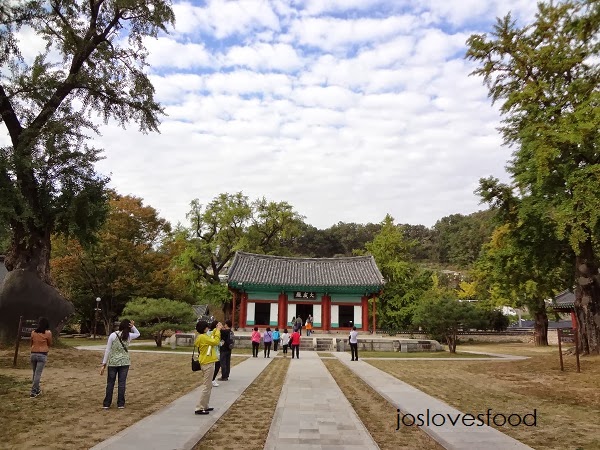
The Jeonju Hyanggyo (Confucian School) was around the vicinity of the hanok village.  It was a Confucian School established during the Joseon Period (1392-1910) and is currently a designated historial treasure no. 379.  The school was originally located in the Gyeonggijeon and was relocated to the present site in 1603.


In the center of Daeseongjeon are the 5 tablets of Confucius Philosopher, Kongzi, Yangzi, Tsengtzu, Zishi, and Mengzi. There are five big and old ginkgo trees in Confucian School, the one in front of West gate in Confucian school is 400 years old. It is said that the meaning of planting ginkgo trees in Confucian school is for students of Confucianism to become an upright person as the ginkgo trees do not get infested with insects.


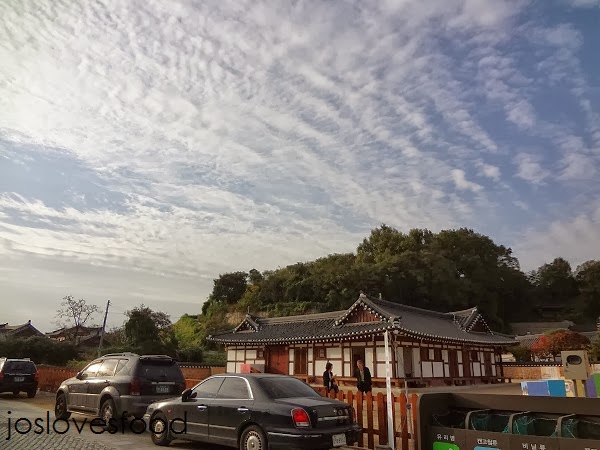
As I walked along the clean and quiet alleys, I can't help noticing the beautiful cloudy sky since the buildings were low, mostly in single storey.


The little town is complete with services and facilities for shopping, eating and public services.  The above is a small post office by Korea Post.


There is also a little dessert shop that sold patbingsu, shaved ice which is a popular Korean summer dessert, complete with red bean and rice cakes.  In fact, the shop serves only 3 types of desserts.  That's how simple life was in the town.


Back in the hanok house, the backyard is filled with homemade gochujang, a savoury and pungent Korean condiment made from red chilli, glutinous rice and fermented soy beans and salt.  The traditional way of making gochujang was to let the ingredients ferment for years in the large earthen pots left outdoors.  I suppose with modernisation, such ways of making gochujang could only be found in the country side or at such traditional houses.  It was an eye opener to see so many large earthern pots lining in the backyard.

With the relaxing pace of life and closeness to nature in the hanok village, it is an experience which is difficult or almost impossible to find in our present city life.


Getting to Jeonju Hanok Village

Seoul → JeonjuSeoul Central Terminal Jeonju Express Bus Terminal
(First bus - 05:30 / Last bus - 24:00 / Runs every 10 minutes / Travel time - 2 hours, 45 minutes)
Jeonju Express Bus Terminal → Jeonju Hanok Village
* Take Bus 5-1 from the bus stop located 150m away from the taxi stand on the opposite side of the street (towards Inter-city bus terminal direction).
(Bus runs every 15 minutes / Travel time: around 15 minutes).

* Take Bus 79 from the bus stop in front of the terminal main gate.
(Runs every 25 minutes / Travel time: around 15 minutes).

* Take a taxi: approximately 10 minutes.

Alternatively, take the KTX at Yongsan Station (Station) via the Jeolla line.  (~ 2hr 14 mins, 6 stops).  At Jeonju station, transfer to bus 513 in the direction of Jeonju Hyanggyo. (~17mins, 13 stops)


View Larger Map
Related Posts Plugin for WordPress, Blogger...